
In Template pattern, an abstract class exposes defined
way(s)/template(s) to execute its methods. Its subclasses can override
the method implementation as per need but the invocation is to be in the
same way as defined by an abstract class. This pattern comes under
behavior pattern category.
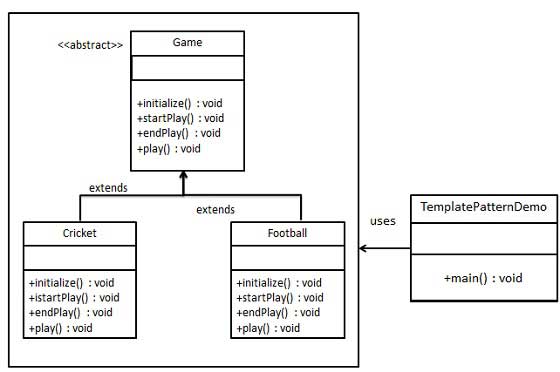
TemplatePatternDemo, our demo class, will use Game to demonstrate use of template pattern.
Game.java
Cricket.java
TemplatePatternDemo.java
Implementation
We are going to create a Game abstract class defining operations with a template method set to be final so that it cannot be overridden. Cricket and Football are concrete classes that extend Game and override its methods.TemplatePatternDemo, our demo class, will use Game to demonstrate use of template pattern.
Step 1
Create an abstract class with a template method being final.Game.java
public abstract class Game {
   abstract void initialize();
   abstract void startPlay();
   abstract void endPlay();

   //template method
   public final void play(){

      //initialize the game
      initialize();

      //start game
      startPlay();

      //end game
      endPlay();
   }
}
Step 2
Create concrete classes extending the above class.Cricket.java
public class Cricket extends Game {

   @Override
   void endPlay() {
      System.out.println("Cricket Game Finished!");
   }

   @Override
   void initialize() {
      System.out.println("Cricket Game Initialized! Start playing.");
   }

   @Override
   void startPlay() {
      System.out.println("Cricket Game Started. Enjoy the game!");
   }
}
Football.java
public class Football extends Game {

   @Override
   void endPlay() {
      System.out.println("Football Game Finished!");
   }

   @Override
   void initialize() {
      System.out.println("Football Game Initialized! Start playing.");
   }

   @Override
   void startPlay() {
      System.out.println("Football Game Started. Enjoy the game!");
   }
}
Step 3
Use the Game's template method play() to demonstrate a defined way of playing game.TemplatePatternDemo.java
public class TemplatePatternDemo {
   public static void main(String[] args) {

      Game game = new Cricket();
      game.play();
      System.out.println();
      game = new Football();
      game.play();
   }
}
Step 4
Verify the output.Cricket Game Initialized! Start playing. Cricket Game Started. Enjoy the game! Cricket Game Finished! Football Game Initialized! Start playing. Football Game Started. Enjoy the game! Football Game Finished!


No comments:
Post a Comment