COBOL is a high-level language. One must understand the way COBOL
works. Computers only understand machine code, a binary stream of 0s and
1s. COBOL code must be converted into machine code using a compiler.

Showing posts with label COBOL Tutorial. Show all posts
Showing posts with label COBOL Tutorial. Show all posts
Friday, January 27, 2017


COBOL - Environment Setup
Try it Option Online
We have set up the COBOL Programming environment online, so that you can compile and execute all the available examples online. It gives you confidence in what you are reading and enables you to verify the programs with different options. Feel free to modify any example and execute it online.
COBOL - Program Structure
A COBOL program structure consists of divisions as shown in the following image:
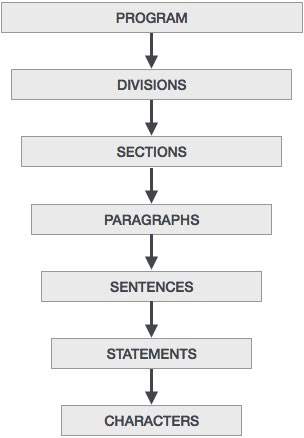 A brief introduction of these divisions is given below:
A brief introduction of these divisions is given below:COBOL - Basic Syntax
Character Set
'Characters' are lowest in the hierarchy and they cannot be divided further. The COBOL Character Set includes 78 characters which are shown below:COBOL - Data Types
Data Division is used to define the variables used in a program. To
describe data in COBOL, one must understand the following terms:
- Data Name
- Level Number
- Picture Clause
- Value Clause
COBOL - Basic Verbs
COBOL verbs are used in the procedure division for data processing. A
statement always start with a COBOL verb. There are several COBOL verbs
with different types of actions.
COBOL - Data Layout
COBOL layout is the description of use of each field and the values
present in it. Following are the data description entries used in COBOL:
- Redefines Clause
- Renames Clause
- Usage Clause
- Copybooks
COBOL - Condition Statements
Conditional statements are used to change the execution flow
depending on certain conditions specified by the programmer. Conditional
statements will always evaluate to true or false. Conditions are used
in IF, Evaluate and Perform statements. The different types of
conditions are as follows:
COBOL - Loop Statements
There are some tasks that need to be done over and over again like
reading each record of a file till its end. The loop statements used in
COBOL are:
- Perform Thru
- Perform Until
- Perform Times
- Perform Varying
COBOL - String Handling
String handling statements in COBOL are used to do multiple
functional operations on strings. Following are the string handling
statements:
- Inspect
- String
- Unstring
COBOL - Table Processing
Arrays in COBOL are known as tables. An array is a linear data
structure and is collection of individual data items of same type. Data
items of a table are internally sorted.
COBOL - File Handling
The concept of files in COBOL is different from that in C/C++. While
learning the basics of 'File' in COBOL, the concepts of both languages
should not be co-related. Simple text files cannot be used in COBOL,
instead PS (Physical Sequential) and VSAM files are used. PS files will be discussed in this module.
COBOL - File Organization
File organization indicates how the records are organized in a file.
There are different types of organizations for files so as to increase
their efficiency of accessing the records. Following are the types of
file organization schemes:
COBOL - File Access Mode
Till now, file organization schemes have been discussed. For each
file organization scheme, different access modes can be used. Following
are the types of file access modes:
- Sequential Access
- Random Access
- Dynamic Access
COBOL - File Handling Verbs
File handling verbs are used to perform various operations on files. Following are the file handling verbs:
- Open
- Read
- Write
- Rewrite
- Delete
- Start
- Close
COBOL - Subroutines
Cobol subroutine is a program that can be compiled independently but
cannot be executed independently. There are two types of subroutines: internal subroutines like Perform statements and external subroutines like CALL verb.
COBOL - Internal Sort
Sorting of data in a file or merging of two or more files is a common
necessity in almost all business-oriented applications. Sorting is used
for arranging records either in ascending or descending order, so that
sequential processing can be performed. There are two techniques which
are used for sorting files in COBOL:
COBOL - Database Interface
As of now, we have learnt the use of files in COBOL. Now, we will
discuss how a COBOL program interacts with DB2. It involves the
following terms:
- Embedded SQL
- DB2 Application Programming
- Host Variables
- SQLCA
- SQL Queries
- Cursors
COBOL Interview Questions
Dear readers, these COBOL Interview Questions have been
designed especially to get you acquainted with the nature of questions
you may encounter during your interview for the subject of COBOL Programming Language.
As per my experience, good interviewers hardly plan to ask any
particular question during your interview.
COBOL Questions and Answers
COBOL Questions and Answers has been designed with a special intention of helping students and professionals preparing for various Certification Exams and Job Interviews.
This section provides a useful collection of sample Interview Questions
and Multiple Choice Questions (MCQs) and their answers with
appropriate explanations.
Subscribe to:
Posts (Atom)