পৃষ্ঠাসমূহ

Search Your Article

CS


Welcome to GoogleDG – your one-stop destination for free learning resources, guides, and digital tools.

At GoogleDG, we believe that knowledge should be accessible to everyone. Our mission is to provide readers with valuable ebooks, tutorials, and tech-related content that makes learning easier, faster, and more enjoyable.

What We Offer:

  • 📘 Free & Helpful Ebooks – covering education, technology, self-development, and more.

  • 💻 Step-by-Step Tutorials – practical guides on digital tools, apps, and software.

  • 🌐 Tech Updates & Tips – simplified information to keep you informed in the fast-changing digital world.

  • 🎯 Learning Support – resources designed to support students, professionals, and lifelong learners.

    Latest world News 


Our Vision

To create a digital knowledge hub where anyone, from beginners to advanced learners, can find trustworthy resources and grow their skills.

Why Choose Us?

✔ Simple explanations of complex topics
✔ 100% free access to resources
✔ Regularly updated content
✔ A community that values knowledge sharing

We are continuously working to expand our content library and provide readers with the most useful and relevant digital learning materials.

📩 If you’d like to connect, share feedback, or suggest topics, feel free to reach us through the Contact page.

Pageviews

Thursday, February 16, 2017

Electron - Installation

To get started with developing using the Electron, you need to have Node and npm(node package manager) installed. If you don’t already have these, head over to Node setup to install node on your local system. Confirm that node and npm are installed by running the following commands in your terminal.

node --version
npm --version
You should get the output:
v6.9.1
3.10.8
Whenever we create a project using npm, we need to provide a package.json file, which has all the details about our project. npm make it easy for us to set up this file. Let us set up our development project.
  1. Fire up your terminal/cmd, create a new folder named hello-world and cd into it.
  2. Now to create the package.json file using npm, use the following.
    npm init
  3. It’ll ask you for the following information:
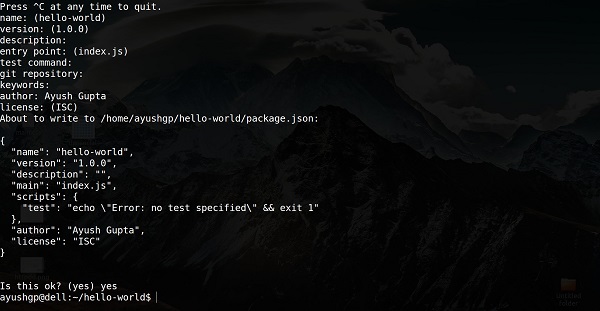
    Package.json creation Just keep pressing enter, and enter your name at the “author name” field.
Create a new folder and cd into it. Now run the following command to install Electron globally.
$ npm install -g electron-prebuilt
Once it executes you can check if electron installed correctly by running:
$ electron --version
You should get the output:
v1.4.13
Now that we've set up electron, lets move on to creating our first app using it!

No comments:

Post a Comment