
Handling file upload in Flask is very easy. It needs an HTML form with its enctype attribute set to ‘multipart/form-data’, posting the file to a URL. The URL handler fetches file from request.files[] object and saves it to the desired location.
Each uploaded file is first saved in a temporary location on the server, before it is actually saved to its ultimate location. Name of destination file can be hard-coded or can be obtained from filename property of request.files[file] object. However, it is recommended to obtain a secure version of it using the secure_filename() function.
It is possible to define the path of default upload folder and maximum size of uploaded file in configuration settings of Flask object.
The following code has ‘/upload’ URL rule that displays ‘upload.html’ from the templates folder, and ‘/upload-file’ URL rule that calls uploader() function handling upload process.
‘upload.html’ has a file chooser button and a submit button.
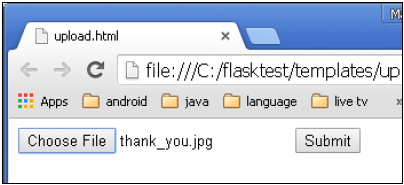 Click Submit after choosing file. Form’s post method invokes ‘/upload_file’ URL. The underlying function uploader() does the save operation.
Following is the Python code of Flask application.
Each uploaded file is first saved in a temporary location on the server, before it is actually saved to its ultimate location. Name of destination file can be hard-coded or can be obtained from filename property of request.files[file] object. However, it is recommended to obtain a secure version of it using the secure_filename() function.
It is possible to define the path of default upload folder and maximum size of uploaded file in configuration settings of Flask object.
| app.config[‘UPLOAD_FOLDER’] | Defines path for upload folder |
| app.config[‘MAX_CONTENT_PATH’] | Specifies maximum size of file yo be uploaded – in bytes |
‘upload.html’ has a file chooser button and a submit button.
<html>
   <body>

      <form action = "http://localhost:5000/uploader" method = "POST"
         enctype = "multipart/form-data">
         <input type = "file" name = "file" />
         <input type = "submit"/>
      </form>

   </body>
</html>
You will see the screen as shown below.
Click Submit after choosing file. Form’s post method invokes ‘/upload_file’ URL. The underlying function uploader() does the save operation.Following is the Python code of Flask application.
from flask import Flask, render_template, request
from werkzeug import secure_filename
app = Flask(__name__)

@app.route('/upload')
def upload_file():
   return render_template('upload.html')

@app.route('/uploader', methods = ['GET', 'POST'])
def upload_file():
   if request.method == 'POST':
      f = request.files['file']
      f.save(secure_filename(f.filename))
      return 'file uploaded successfully'

if __name__ == '__main__':
   app.run(debug = True)


No comments:
Post a Comment