Flex provides two ways to create custom components.
- Using ActionScript
- Using MXML
Using ActionScript
You can create a component by extending existing component. To create a component using Flash Builder, Click on
File > New > ActionScript Class. Enter the details as shown below.
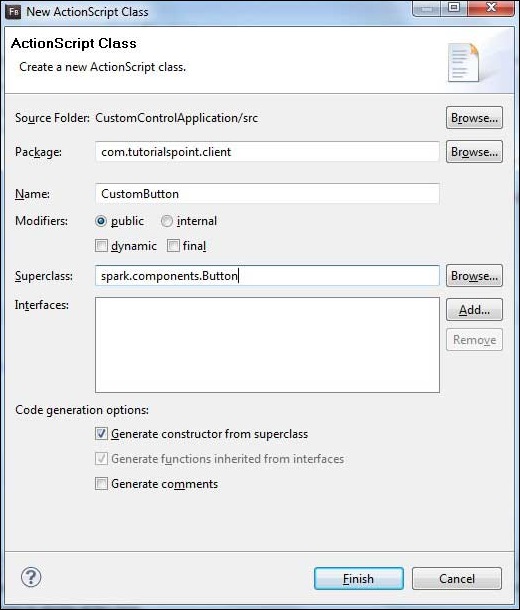
Flash Builder will create the following CustomButton.as file.
package com.tutorialspoint.client
{
   import spark.components.Button;

   public class CustomButton extends Button
   {
      public function CustomButton()
      {
         super();
      }
   }
}
Using MXML
You can create a component by extending existing component. To create a component using Flash Builder, Click on
File > New > MXML Component. Enter the details as shown below.
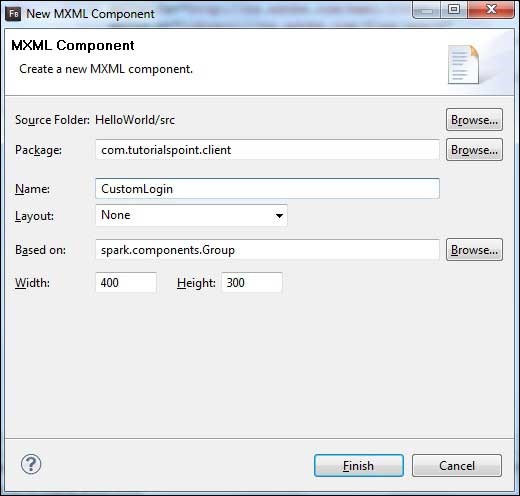
Flash Builder will create the following CustomLogin.mxml file.
<?xml version="1.0" encoding="utf-8"?>
<s:Group xmlns:fx="http://ns.adobe.com/mxml/2009"
   xmlns:s="library://ns.adobe.com/flex/spark"
   xmlns:mx="library://ns.adobe.com/flex/mx"
   width="400" height="300">

</s:Group>
Let us follow the following steps to test custom controls in a Flex application:
| Step | Description |
|---|
| 1 | Create a project with a name HelloWorld under a package com.tutorialspoint.client as explained in the Flex - Create Application chapter. |
| 2 | Modify HelloWorld.mxml as explained below. Keep rest of the files unchanged. |
| 4 | Create CustomLogin.mxml and CustomButton.as component as explained above. Modify these files as explained below. Keep rest of the files unchanged. |
| 3 | Compile and run the application to make sure business logic is working as per the requirements. |
Following is the content of the modified mxml file
src/com.tutorialspoint/client/CustomLogin.mxml.
<?xml version="1.0" encoding="utf-8"?>
<s:Group xmlns:fx="http://ns.adobe.com/mxml/2009"
   xmlns:s="library://ns.adobe.com/flex/spark"
   xmlns:mx="library://ns.adobe.com/flex/mx" width="400" height="300">
   <s:Form>
      <s:FormItem label="UserName:">
         <s:TextInput width="200" />
      </s:FormItem>
      <s:FormItem label="Password:">
         <s:TextInput width="200"
            displayAsPassword="true" />
      </s:FormItem>
      <s:FormItem>
         <s:Button label="Login" />
      </s:FormItem>
   </s:Form>
</s:Group>
Following is the content of the modified mxml file
src/com.tutorialspoint/client/CustomButton.as.
package com.tutorialspoint.client
{
   import spark.components.Button;

   public class CustomButton extends Button
   {
      public function CustomButton()
      {
         super();
         this.setStyle("color","green");
         this.label = "Submit";
      }
   }
}
Following is the content of the modified mxml file
src/com.tutorialspoint/client/HelloWorld.mxml.
<?xml version="1.0" encoding="utf-8"?>
<s:Application xmlns:fx="http://ns.adobe.com/mxml/2009"
   xmlns:s="library://ns.adobe.com/flex/spark"
   xmlns:mx="library://ns.adobe.com/flex/mx"
   xmlns:client="com.tutorialspoint.client.*"
   initialize="application_initializeHandler(event)"
   >
   <fx:Style source="/com/tutorialspoint/client/Style.css"/>
   <fx:Script>
      <![CDATA[
        import mx.events.FlexEvent;

        protected function application_initializeHandler(event:FlexEvent):void
        {
           //create a new custom button
           var customButton: CustomButton = new CustomButton();
           asPanel.addElement(customButton);
        }

      ]]>
   </fx:Script>
   <s:BorderContainer width="630" height="480" id="mainContainer"
      styleName="container">
      <s:VGroup width="100%" height="100%" gap="10"
         horizontalAlign="center" verticalAlign="middle">
         <s:Label id="lblHeader" text="Custom Controls Demonstration"
            fontSize="40" color="0x777777" styleName="heading"/>

         <s:Panel title="Using MXML Component" width="400" height="200">
            <client:CustomLogin>
            </client:CustomLogin>
         </s:Panel>
         <s:Panel  title="Using AS Component" width="400" height="100">
            <s:VGroup id="asPanel" width="100%" height="100%" gap="10"
               horizontalAlign="center" verticalAlign="middle">
            </s:VGroup>
         </s:Panel>
      </s:VGroup>
   </s:BorderContainer>
</s:Application>
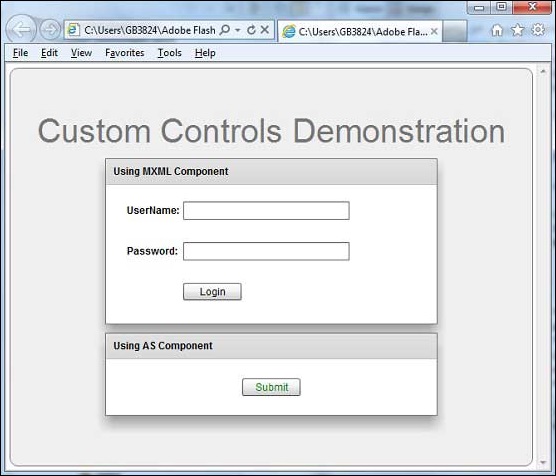
Once you are ready with all the changes done, let us compile and run the application in normal mode as we did in
Flex - Create Application chapter. If everything is fine with your application, this will produce following result: [
Try it online ]


No comments:
Post a Comment