
Properties validation is useful way to force correct usage of your
components. This will help you during development to avoid future bugs
and problems once your app become larger. It also makes code more
readable since you can see how each component should be used.
 You probably noticed that we use isRequired when validating propArray and propBool. This will give us error if one of those two don't exist. If we delete propArray: [1,2,3,4,5] from the App.defaultProps object, the console will log warning.
 If we set the value of propArray: 1, React will warn us that the propType validation failed since we need array and we got number.

Validating Props
In this example we are creating App component with all the props that we need. App.propTypes is used for props validation. If some of the props aren't using correct type that we assigned, we will get console warning. After we specified validation patterns, we are setting App.defaultProps.App.jsx
import React from 'react';

class App extends React.Component {
   render() {
      return (
         <div>
            <h3>Array: {this.props.propArray}</h3>
            <h3>Bool: {this.props.propBool ? "True..." : "False..."}</h3>
            <h3>Func: {this.props.propFunc(3)}</h3>
            <h3>Number: {this.props.propNumber}</h3>
            <h3>String: {this.props.propString}</h3>
            <h3>Object: {this.props.propObject.objectName1}</h3>
            <h3>Object: {this.props.propObject.objectName2}</h3>
            <h3>Object: {this.props.propObject.objectName3}</h3>
         </div>
      );
   }
}

App.propTypes = {
   propArray: React.PropTypes.array.isRequired,
   propBool: React.PropTypes.bool.isRequired,
   propFunc: React.PropTypes.func,
   propNumber: React.PropTypes.number,
   propString: React.PropTypes.string,
   propObject: React.PropTypes.object
}

App.defaultProps = {
   propArray: [1,2,3,4,5],
   propBool: true,
   propFunc: function(e){return e},
   propNumber: 1,
   propString: "String value...",

   propObject: {
      objectName1:"objectValue1",
      objectName2: "objectValue2",
      objectName3: "objectValue3"
   }
}

export default App;
main.js
import React from 'react';
import ReactDOM from 'react-dom';
import App from './App.jsx';

ReactDOM.render(<App/>, document.getElementById('app'));
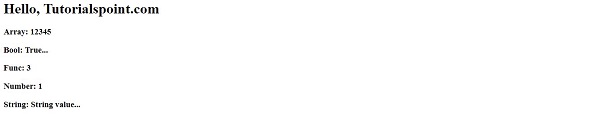
Since all props are valid, we will get the following result.
You probably noticed that we use isRequired when validating propArray and propBool. This will give us error if one of those two don't exist. If we delete propArray: [1,2,3,4,5] from the App.defaultProps object, the console will log warning.
If we set the value of propArray: 1, React will warn us that the propType validation failed since we need array and we got number.

No comments:
Post a Comment