
Because HTTP is stateless, in order to associate a request to any other request, you need a way to store user data between HTTP requests. Cookies and URL parameters are both suitable ways to transport data between client and server. But they are both readable and on the client side. Sessions solve exactly this problem. You assign the client an ID and it makes all further requests using that ID. Information associated with the client is stored on the server linked to this ID.
We'll need the koa-session, so install it using:
Whenever we make a request from the same client again, we will have their session information stored with us(given that server was not restarted). We can add more properties to this session object. In the following example, we will create a view counter for a client.
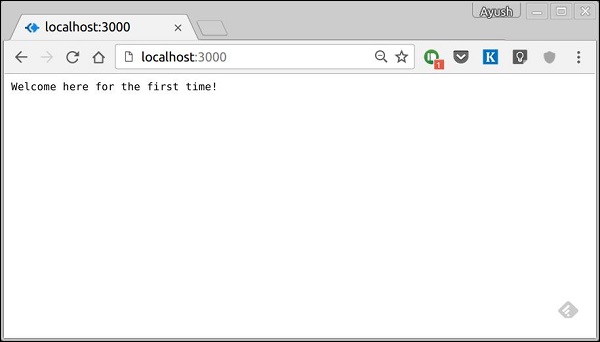
Now if you run the app and go to localhost:3000, you'll get the response:
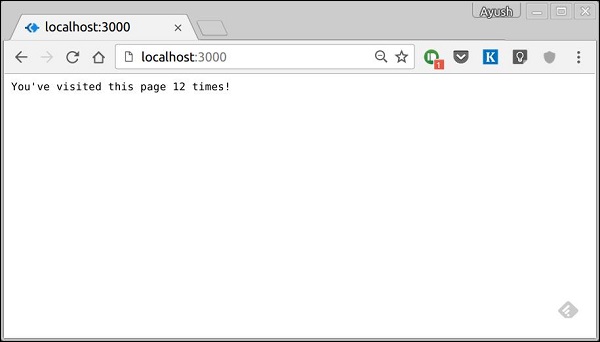
 If you revisit the page, the page counter will increase. I refreshed the page 12 times in this case:
We'll need the koa-session, so install it using:
npm install --save koa-sessionWe will put the koa-session middleware in place. In this example, we'll use the our RAM to store sessions. Never use this in production environments. The session middleware handles all things for us, ie creating the session, setting the session cookie and creating the session object in context object.
Whenever we make a request from the same client again, we will have their session information stored with us(given that server was not restarted). We can add more properties to this session object. In the following example, we will create a view counter for a client.
var session = require('koa-session');
var koa = require('koa');
var app = koa();

app.keys = ['Shh, its a secret!'];
app.use(session(app));  // Include the session middleware

app.use(function *(){
  var n = this.session.views || 0;
  this.session.views = ++n;
  if(n === 1)
   this.body = 'Welcome here for the first time!';
  else
   this.body = "You've visited this page " + n + " times!";
})

app.listen(3000);
What the above code does is, when a user visits the site, it creates a new session for the user and assigns them a cookie. Next time the user comes, the cooie is checked and the page_view session variable is updated accordingly.
Now if you run the app and go to localhost:3000, you'll get the response:
If you revisit the page, the page counter will increase. I refreshed the page 12 times in this case:

No comments:
Post a Comment