
Failure of system needs to be handled effectively for smooth running
of the system. CakePHP comes with default error trapping that prints and
logs error as they occur. This same error handler is used to catch Exceptions.
Error handler displays errors when debug is true and logs error when
debug is false.
CakePHP has number of exception classes and the built in exception handling will capture any uncaught exception and render a useful page.
config/routes.php
src/Controller/ExpsController.php
src/Template/Exps/index.ctp
http://localhost:85/CakePHP/exception/5/0
CakePHP has number of exception classes and the built in exception handling will capture any uncaught exception and render a useful page.
Errors and Exception Configuration
Errors and Exception can be configured in file config\app.php. Error handling accepts a few options that allow you to tailor error handling for your application −| Option | Data Type | Description |
|---|---|---|
| errorLevel | int | The level of errors you are interested in capturing. Use the built-in php error constants, and bitmasks to select the level of error you are interested in. |
| trace | bool | Include stack traces for errors in log files. Stack traces will be included in the log after each error. This is helpful for finding where/when errors are being raised. |
| exceptionRenderer | string | The class responsible for rendering uncaught exceptions. If you choose a custom class, you should place the file for that class in src/Error. This class needs to implement a render() method. |
| log | bool | When true, exceptions + their stack traces will be logged to Cake\Log\Log. |
| skipLog | array | An array of exception classnames that should not be logged. This is useful to remove NotFoundExceptions or other common, but uninteresting logs messages. |
| extraFatalErrorMemory | int | Set to the number of megabytes to increase the memory limit by when a fatal error is encountered. This allows breathing room to complete logging or error handling. |
Example
Make changes in the config/routes.php file as shown in the following code.config/routes.php
<?php
   use Cake\Core\Plugin;
   use Cake\Routing\RouteBuilder;
   use Cake\Routing\Router;

   Router::defaultRouteClass('DashedRoute');
   Router::scope('/', function (RouteBuilder $routes) {
      $routes->connect('/exception/:arg1/:arg2',[
         'controller'=>'Exps','action'=>'index'],['pass' => ['arg1', 'arg2']]);
      $routes->fallbacks('DashedRoute');
   });
   Plugin::routes();
Create ExpsController.php file at src/Controller/ExpsController.php. Copy the following code in the controller file.
src/Controller/ExpsController.php
<?php
   namespace App\Controller;
   use App\Controller\AppController;
   use Cake\Core\Exception\Exception;

   class ExpsController extends AppController{
      public function index($arg1,$arg2){
         try{
            $this->set('argument1',$arg1);
            $this->set('argument2',$arg2);

            if(($arg1 < 1 || $arg1 > 10) || ($arg2 < 1 || $arg2 > 10))
            throw new Exception("One of the number is out of range[1-10].");
         }catch(\Exception $ex){
            echo $ex->getMessage();
         }
      }
   }
?>
Create a directory Exps at src/Template and under that directory create a View file called index.ctp. Copy the following code in that file.
src/Template/Exps/index.ctp
This is CakePHP tutorial and this is an example of Passed arguments.
Argument-1: <?=$argument1?>
Argument-2: <?=$argument2?>
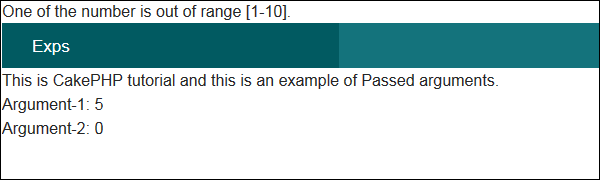
Execute the above example by visiting the following URL.
http://localhost:85/CakePHP/exception/5/0
Output
Upon execution, you will receive the following output.

No comments:
Post a Comment