
AJAX stands for Asynchronous JavaScript and XML. It is a technique for creating better, faster and more interactive web applications with the help of XML, JSON, HTML, CSS, and JavaScript. AJAX allows you to send and receive data asynchronously without reloading the web page, so it is fast.
This Zone component is used along with an EventLink component. An EventLink has option to tie it to a particular zone using the t:zone attributes. Once the zone is configured in EventLink, clicking the EventLink will trigger the zone update. In addition, the EventLink events (refreshZone) can be used to control the generation of dynamic data.
A simple example of AJAX is as follows −
Zone Component
A Zone Component is used to provide the content (markup) as well as the position of the content itself. The body of the Zone Component is used internally by Tapestry to generate the content. Once the dynamic content is generated, Tapestry will send it to the client, rerender the data in the correct place, trigger and animate the HTML to draw the attention of the user.This Zone component is used along with an EventLink component. An EventLink has option to tie it to a particular zone using the t:zone attributes. Once the zone is configured in EventLink, clicking the EventLink will trigger the zone update. In addition, the EventLink events (refreshZone) can be used to control the generation of dynamic data.
A simple example of AJAX is as follows −
AjaxZone.tml
<html t:type = "Newlayout" title = "About MyFirstApplication"
   xmlns:t = "http://tapestry.apache.org/schema/tapestry_5_4.xsd"
   xmlns:p = "tapestry:parameter">

   <body>
      <h1>Ajax time zone example</h1>
      <div class = "div1">
         <a t:type = "eventlink" t:event = "refreshZone" href = "#"
            t:zone = "timeZone">Ajax Link </a><br/><br/>
         <t:zone t:id = "timeZone" id = "timeZone">Time zone: ${serverTime}</t:zone>
      </div>
   </body>

</html>
AjaxZone.java
package com.example.MyFirstApplication.pages;

import java.util.Date;
import org.apache.tapestry5.annotations.InjectComponent;
import org.apache.tapestry5.corelib.components.Zone;
import org.apache.tapestry5.ioc.annotations.Inject;
import org.apache.tapestry5.services.Request;

public class AjaxZone {
   @Inject
   private Request request;

   @InjectComponent
   private Zone timeZone;

   void onRefreshPage() {
   }

   Object onRefreshZone() {
      return request.isXHR() ? timeZone.getBody() : null;
   }

   public Date getServerTime() {
      return new Date();
   }
}
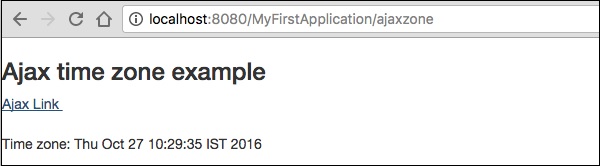
The result will show at: http://localhost:8080/MyFirstApplication/AjaxZone


No comments:
Post a Comment