
Interpreter pattern provides a way to evaluate language grammar or
expression. This type of pattern comes under behavioral pattern. This
pattern involves implementing an expression interface which tells to
interpret a particular context. This pattern is used in SQL parsing,
symbol processing engine etc.
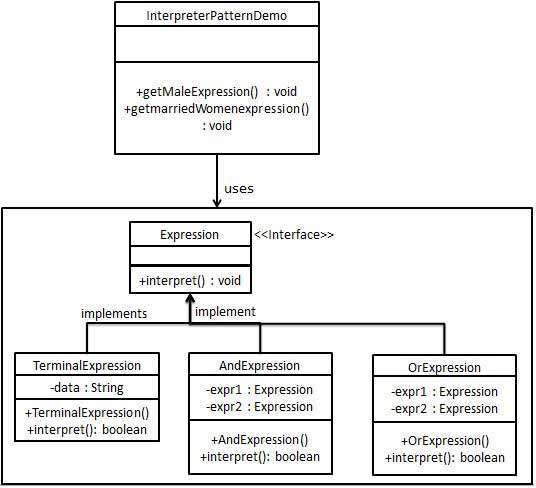
InterpreterPatternDemo, our demo class, will use Expression class to create rules and demonstrate parsing of expressions.
Expression.java
TerminalExpression.java
InterpreterPatternDemo.java
Implementation
We are going to create an interface Expression and concrete classes implementing the Expression interface. A class TerminalExpression is defined which acts as a main interpreter of context in question. Other classes OrExpression, AndExpression are used to create combinational expressions.InterpreterPatternDemo, our demo class, will use Expression class to create rules and demonstrate parsing of expressions.
Step 1
Create an expression interface.Expression.java
public interface Expression {
   public boolean interpret(String context);
}
Step 2
Create concrete classes implementing the above interface.TerminalExpression.java
public class TerminalExpression implements Expression {

   private String data;

   public TerminalExpression(String data){
      this.data = data;
   }

   @Override
   public boolean interpret(String context) {

      if(context.contains(data)){
         return true;
      }
      return false;
   }
}
OrExpression.java
public class OrExpression implements Expression {

   private Expression expr1 = null;
   private Expression expr2 = null;

   public OrExpression(Expression expr1, Expression expr2) {
      this.expr1 = expr1;
      this.expr2 = expr2;
   }

   @Override
   public boolean interpret(String context) {
      return expr1.interpret(context) || expr2.interpret(context);
   }
}
AndExpression.java
public class AndExpression implements Expression {

   private Expression expr1 = null;
   private Expression expr2 = null;

   public AndExpression(Expression expr1, Expression expr2) {
      this.expr1 = expr1;
      this.expr2 = expr2;
   }

   @Override
   public boolean interpret(String context) {
      return expr1.interpret(context) && expr2.interpret(context);
   }
}
Step 3
InterpreterPatternDemo uses Expression class to create rules and then parse them.InterpreterPatternDemo.java
public class InterpreterPatternDemo {

   //Rule: Robert and John are male
   public static Expression getMaleExpression(){
      Expression robert = new TerminalExpression("Robert");
      Expression john = new TerminalExpression("John");
      return new OrExpression(robert, john);
   }

   //Rule: Julie is a married women
   public static Expression getMarriedWomanExpression(){
      Expression julie = new TerminalExpression("Julie");
      Expression married = new TerminalExpression("Married");
      return new AndExpression(julie, married);
   }

   public static void main(String[] args) {
      Expression isMale = getMaleExpression();
      Expression isMarriedWoman = getMarriedWomanExpression();

      System.out.println("John is male? " + isMale.interpret("John"));
      System.out.println("Julie is a married women? " + isMarriedWoman.interpret("Married Julie"));
   }
}
Step 4
Verify the output.John is male? true Julie is a married women? true


No comments:
Post a Comment