
We can now define routes, but those are static or fixed. To use
dynamic routes, we need to provide different types of routes. Using
dynamic routes allows us to pass parameters and process based on them.
Here is an example of a dynamic route:
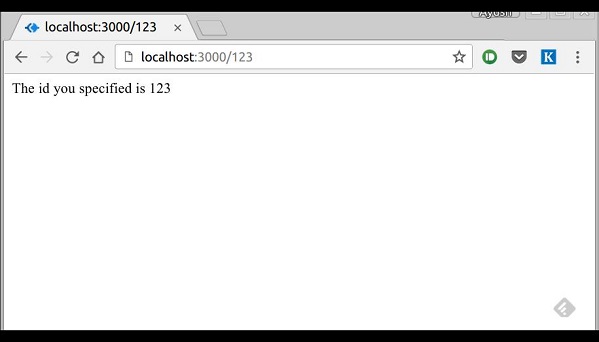 You can replace '123' in the url with anything else and it'll be
reflected in the response. A more complex example of the above is:
You can replace '123' in the url with anything else and it'll be
reflected in the response. A more complex example of the above is:
 You can use the req.params object to access all the parameters
you pass in the url. Note that the above 2 are different paths. They
will never overlap. Also if you want to execute code when you get
'/things' then you need to define it separately.
You can use the req.params object to access all the parameters
you pass in the url. Note that the above 2 are different paths. They
will never overlap. Also if you want to execute code when you get
'/things' then you need to define it separately.
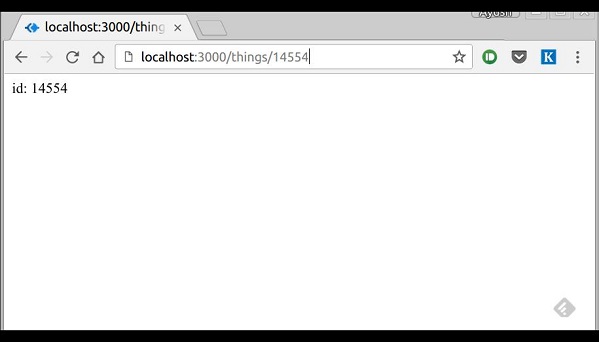
For example, if we define the same routes as above, on requesting with an valid URL, we get:
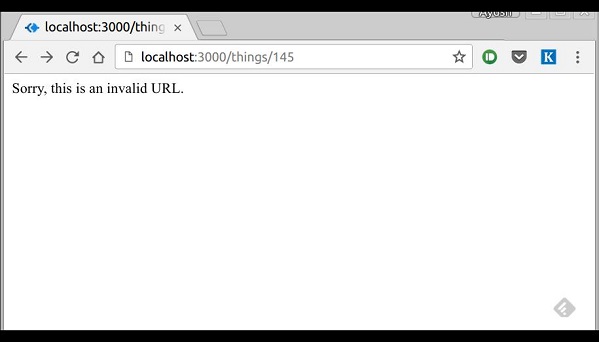
 While for an incorrect URL request, we get:
var express = require('express');
var app = express();

app.get('/:id', function(req, res){
    res.send('The id you specified is ' + req.params.id);
});

app.listen(3000);
To test this go to http://localhost:3000/123. You should get the response as
You can replace '123' in the url with anything else and it'll be
reflected in the response. A more complex example of the above is:
var express = require('express');
var app = express();

app.get('/things/:name/:id', function(req, res){
    res.send('id: ' + req.params.id + ' and name: ' + req.params.name);
});

app.listen(3000);
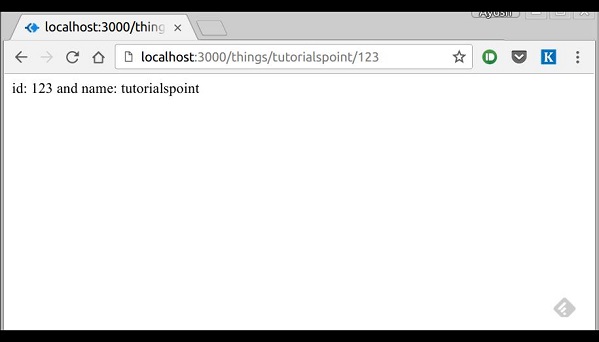
To test this go to http://localhost:3000/things/tutorialspoint/12345.
You can use the req.params object to access all the parameters
you pass in the url. Note that the above 2 are different paths. They
will never overlap. Also if you want to execute code when you get
'/things' then you need to define it separately. Pattern matched routes
You can also use regex to restrict URL parameter matching. Let's say you need the id to be 5 digits long number. You can use the following route definition:var express = require('express'); var app = express(); app.get('/things/:id([0-9]{5})', function(req, res){ res.send('id: ' + req.params.id); }); app.listen(3000);Note that this will only match the requests that have a 5 digit long id. You can use more complex regexes to match/validate your routes. If none of your routes match the request, you'll get a "Cannot GET <your-request-route>" message as response. This message can be replaced by a 404 not found page using this simple route:
var express = require('express');
var app = express();

//Other routes here

app.get('*', function(req, res){
    res.send('Sorry, this is an invalid URL.');
});

app.listen(3000);
Important: This should be placed after all your routes, as express matches routes from start to end of the index.js file, including the external routers you required.
For example, if we define the same routes as above, on requesting with an valid URL, we get:
While for an incorrect URL request, we get: 

No comments:
Post a Comment