
Erlang is a functional programming language which also has a runtime
environment. It was built in such a way that it had integrated support
for concurrency, distribution and fault tolerance. Erlang was originally
developed to be used in several large telecommunication systems from
Ericsson.
The first version of Erlang was developed by Joe Armstrong, Robert Virding and Mike Williams in 1986. It was originally a proprietary language within Ericsson. It was later released as an open source language in year 1998. Erlang, along with OTP, a collection of middleware and libraries in Erlang, are now supported and maintained by the OTP product unit at Ericsson and widely referred to as Erlang/OTP.
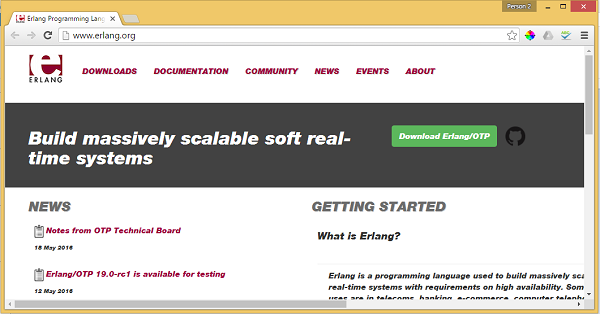
The first version of Erlang was developed by Joe Armstrong, Robert Virding and Mike Williams in 1986. It was originally a proprietary language within Ericsson. It was later released as an open source language in year 1998. Erlang, along with OTP, a collection of middleware and libraries in Erlang, are now supported and maintained by the OTP product unit at Ericsson and widely referred to as Erlang/OTP.
Why Erlang?
Erlang should be used to develop your application, if you have the following requirements −- The application needs to handle a large number of concurrent activities.
- It should be easily distributable over a network of computers.
- There should be a facility to make the application fault-tolerant to both software and hardware errors.
- The application should be scalable. This means that it should have the ability to span across multiple servers with little or no change.
- It should be easily upgradable and reconfigurable without having to stop and restart the application itself.
- The application should be responsive to users within certain strict timeframes.


No comments:
Post a Comment