
A DI(dependency injection) container is an object that knows how to
instantiate and configure objects. Yii provides the DI container via the
yii\di\Container class.
It supports the following kinds of DI −
First.php −
 This approach is convenient as we can set classes in one place and other code will use new classes automatically.
It supports the following kinds of DI −
- Setter and property injection
- PHP callable injection
- Constructor injection
- Controller action injection
class Object1 {
   public function __construct(Object2 $object2) {

   }
}
$object1 = $container->get('Object1');
// which is equivalent to the following:
$object2 = new Object2;
$object1 = new Object1($object2);
Property and setter injections are supported through configurations −
<?php
   use yii\base\Object;
   class MyObject extends Object {
      public $var1;
      private $_var2;
      public function getVar2() {
         return $this->_var2;
      }
      public function setVar2(MyObject2 $var2) {
         $this->_var2 = $var2;
      }
   }
   $container->get('MyObject', [], [
      'var1' => $container->get('MyOtherObject'),
      'var2' => $container->get('MyObject2'),
   ]);
?>
In case of the PHP callable injection, the container will use a registered PHP callback to build new instances of a class −
$container->set('Object1', function () {
   $object1 = new Object1(new Object2);
   return $object1;
});
$object1 = $container->get('Object1');
Controller action injection is a type of DI where dependencies are declared using the type hints. It is useful for keeping the MVC controllers slim light-weighted and slim −
public function actionSendToAdmin(EmailValidator $validator, $email) {
   if ($validator->validate($email)) {
      // sending email
   }
}
You can use the yii\db\Container::set() method to register dependencies −
<?php
   $container = new \yii\di\Container;
   // register a class name as is. This can be skipped.
   $container->set('yii\db\Connection');
   // register an alias name. You can use $container->get('MyObject')
   // to create an instance of Connection
   $container->set('MyObject', 'yii\db\Connection');
   // register an interface
   // When a class depends on the interface, the corresponding class
   // will be instantiated as the dependent object
   $container->set('yii\mail\MailInterface', 'yii\swiftmailer\Mailer');
   // register an alias name with class configuration
   // In this case, a "class" element is required to specify the class
   $container->set('db', [
      'class' => 'yii\db\Connection',
      'dsn' => 'mysql:host=127.0.0.1;dbname = helloworld',
      'username' => 'vladimir',
      'password' => '12345',
      'charset' => 'utf8',
   ]);
   // register a class with configuration. The configuration
   // will be applied when the class is instantiated by get()
   $container->set('yii\db\Connection', [
      'dsn' => 'mysql:host=127.0.0.1;dbname = helloworld',
      'username' => 'vladimir',
      'password' => '12345',
      'charset' => 'utf8',
   ]);
   // register a PHP callable
   // The callable will be executed each time when $container->get('db') is called
   $container->set('db', function ($container, $params, $config) {
      return new \yii\db\Connection($config);
   });
   // register a component instance
   // $container->get('pageCache') will return the same instance each time when it
      //is called
   $container->set('pageCache', new FileCache);
?>
Using the DI
Step 1 − Inside the components folder create a file called MyInterface.php with the following code.<?php namespace app\components; interface MyInterface { public function test(); } ?>Step 2 − Inside the components folder, create two files.
First.php −
<?php
   namespace app\components;
   use app\components\MyInterface;
   class First implements MyInterface {
      public function test() {
         echo "First class <br>";
      }
   }
?>
Second.php −
<?php
   app\components;
   use app\components\MyInterface;
      class Second implements MyInterface {
      public function test() {
         echo "Second class <br>";
      }
   }
?>
Step 3 − Now, add an actionTestInterface to the SiteController.
public function actionTestInterface() {
   $container = new \yii\di\Container();
   $container->set
      ("\app\components\MyInterface","\app\components\First");
   $obj = $container->get("\app\components\MyInterface");
   $obj->test(); // print "First class"
   $container->set
      ("\app\components\MyInterface","\app\components\Second");
   $obj = $container->get("\app\components\MyInterface");
   $obj->test(); // print "Second class"
}
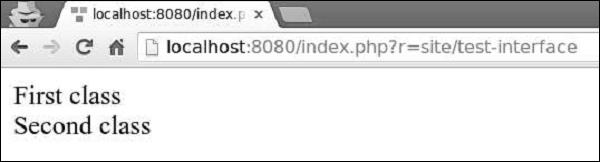
Step 4 − Go to http://localhost:8080/index.php?r=site/test-interface you should see the following.
This approach is convenient as we can set classes in one place and other code will use new classes automatically.

No comments:
Post a Comment