
Mediator pattern is used to reduce communication complexity between
multiple objects or classes. This pattern provides a mediator class
which normally handles all the communications between different classes
and supports easy maintenance of the code by loose coupling. Mediator
pattern falls under behavioral pattern category.
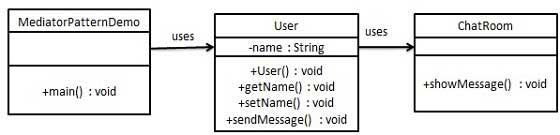
MediatorPatternDemo, our demo class, will use User objects to show communication between them.
ChatRoom.java
User.java
MediatorPatternDemo.java
Implementation
We are demonstrating mediator pattern by example of a chat room where multiple users can send message to chat room and it is the responsibility of chat room to show the messages to all users. We have created two classes ChatRoom and User. User objects will use ChatRoom method to share their messages.MediatorPatternDemo, our demo class, will use User objects to show communication between them.
Step 1
Create mediator class.ChatRoom.java
import java.util.Date;

public class ChatRoom {
   public static void showMessage(User user, String message){
      System.out.println(new Date().toString() + " [" + user.getName() + "] : " + message);
   }
}
Step 2
Create user classUser.java
public class User {
   private String name;

   public String getName() {
      return name;
   }

   public void setName(String name) {
      this.name = name;
   }

   public User(String name){
      this.name  = name;
   }

   public void sendMessage(String message){
      ChatRoom.showMessage(this,message);
   }
}
Step 3
Use the User object to show communications between them.MediatorPatternDemo.java
public class MediatorPatternDemo {
   public static void main(String[] args) {
      User robert = new User("Robert");
      User john = new User("John");

      robert.sendMessage("Hi! John!");
      john.sendMessage("Hello! Robert!");
   }
}
Step 4
Verify the output.Thu Jan 31 16:05:46 IST 2013 [Robert] : Hi! John! Thu Jan 31 16:05:46 IST 2013 [John] : Hello! Robert!


No comments:
Post a Comment