
Facade pattern hides the complexities of the system and provides an
interface to the client using which the client can access the system.
This type of design pattern comes under structural pattern as this
pattern adds an interface to existing system to hide its complexities.
This pattern involves a single class which provides simplified methods required by client and delegates calls to methods of existing system classes.
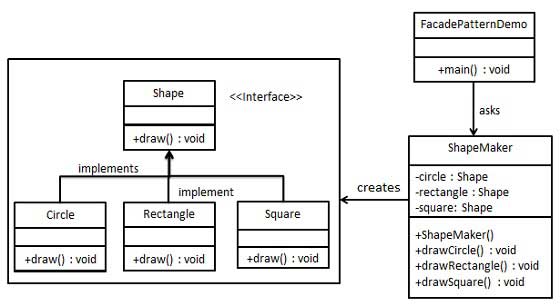
ShapeMaker class uses the concrete classes to delegate user calls to these classes. FacadePatternDemo, our demo class, will use ShapeMaker class to show the results.
Shape.java
Rectangle.java
ShapeMaker.java
FacadePatternDemo.java
This pattern involves a single class which provides simplified methods required by client and delegates calls to methods of existing system classes.
Implementation
We are going to create a Shape interface and concrete classes implementing the Shape interface. A facade class ShapeMaker is defined as a next step.ShapeMaker class uses the concrete classes to delegate user calls to these classes. FacadePatternDemo, our demo class, will use ShapeMaker class to show the results.
Step 1
Create an interface.Shape.java
public interface Shape {
   void draw();
}
Step 2
Create concrete classes implementing the same interface.Rectangle.java
public class Rectangle implements Shape {

   @Override
   public void draw() {
      System.out.println("Rectangle::draw()");
   }
}
Square.java
public class Square implements Shape {

   @Override
   public void draw() {
      System.out.println("Square::draw()");
   }
}
Circle.java
public class Circle implements Shape {

   @Override
   public void draw() {
      System.out.println("Circle::draw()");
   }
}
Step 3
Create a facade class.ShapeMaker.java
public class ShapeMaker {
   private Shape circle;
   private Shape rectangle;
   private Shape square;

   public ShapeMaker() {
      circle = new Circle();
      rectangle = new Rectangle();
      square = new Square();
   }

   public void drawCircle(){
      circle.draw();
   }
   public void drawRectangle(){
      rectangle.draw();
   }
   public void drawSquare(){
      square.draw();
   }
}
Step 4
Use the facade to draw various types of shapes.FacadePatternDemo.java
public class FacadePatternDemo {
   public static void main(String[] args) {
      ShapeMaker shapeMaker = new ShapeMaker();

      shapeMaker.drawCircle();
      shapeMaker.drawRectangle();
      shapeMaker.drawSquare();
   }
}
Step 5
Verify the output.Circle::draw() Rectangle::draw() Square::draw()


No comments:
Post a Comment