
Composite Entity pattern is used in EJB persistence mechanism. A
Composite entity is an EJB entity bean which represents a graph of
objects. When a composite entity is updated, internally dependent
objects beans get updated automatically as being managed by EJB entity
bean. Following are the participants in Composite Entity Bean.
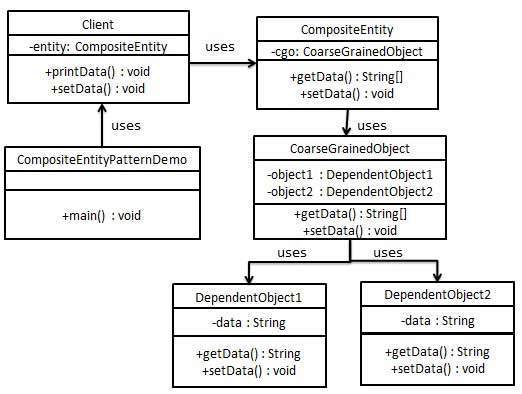
DependentObject1.java
CoarseGrainedObject.java
CompositeEntity.java
Client.java
CompositeEntityPatternDemo.java
- Composite Entity - It is primary entity bean. It can be coarse grained or can contain a coarse grained object to be used for persistence purpose.
- Coarse-Grained Object - This object contains dependent objects. It has its own life cycle and also manages life cycle of dependent objects.
- Dependent Object - Dependent object is an object which depends on coarse grained object for its persistence lifecycle.
- Strategies - Strategies represents how to implement a Composite Entity.
Implementation
We are going to create CompositeEntity object acting as CompositeEntity. CoarseGrainedObject will be a class which contains dependent objects. CompositeEntityPatternDemo, our demo class will use Client class to demonstrate use of Composite Entity pattern.
Step 1
Create Dependent Objects.DependentObject1.java
public class DependentObject1 {

   private String data;

   public void setData(String data){
      this.data = data;
   }

   public String getData(){
      return data;
   }
}
DependentObject2.java
public class DependentObject2 {

   private String data;

   public void setData(String data){
      this.data = data;
   }

   public String getData(){
      return data;
   }
}
Step 2
Create Coarse Grained Object.CoarseGrainedObject.java
public class CoarseGrainedObject {
   DependentObject1 do1 = new DependentObject1();
   DependentObject2 do2 = new DependentObject2();

   public void setData(String data1, String data2){
      do1.setData(data1);
      do2.setData(data2);
   }

   public String[] getData(){
      return new String[] {do1.getData(),do2.getData()};
   }
}
Step 3
Create Composite Entity.CompositeEntity.java
public class CompositeEntity {
   private CoarseGrainedObject cgo = new CoarseGrainedObject();

   public void setData(String data1, String data2){
      cgo.setData(data1, data2);
   }

   public String[] getData(){
      return cgo.getData();
   }
}
Step 4
Create Client class to use Composite Entity.Client.java
public class Client {
   private CompositeEntity compositeEntity = new CompositeEntity();

   public void printData(){

      for (int i = 0; i < compositeEntity.getData().length; i++) {
         System.out.println("Data: " + compositeEntity.getData()[i]);
      }
   }

   public void setData(String data1, String data2){
      compositeEntity.setData(data1, data2);
   }
}
Step 5
Use the Client to demonstrate Composite Entity design pattern usage.CompositeEntityPatternDemo.java
public class CompositeEntityPatternDemo {
   public static void main(String[] args) {

       Client client = new Client();
       client.setData("Test", "Data");
       client.printData();
       client.setData("Second Test", "Data1");
       client.printData();
   }
}
Step 6
Verify the output.Data: Test Data: Data Data: Second Test Data: Data1


No comments:
Post a Comment