
In general, statements are executed sequentially − The first
statement in a function is executed first, followed by the second, and
so on. There may be a situation when you need to execute a block of code
several number of times.
Programming languages provide various control structures that allow more complicated execution paths.
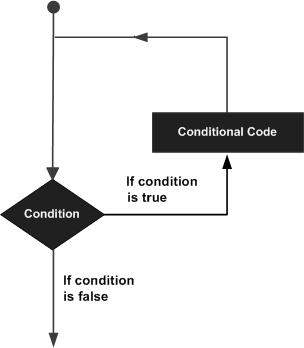
A loop statement allows us to execute a statement or group of statements multiple times. The following diagram illustrates a loop statement −
 Python programming language provides the following types of loops to handle looping requirements.
Python supports the following control statements.
Let us go through the loop control statements briefly.
String, List or Tuple objects can be used to create an Iterator.
When a generator function is called, it returns a generator object without even beginning execution of the function. When the next() method is called for the first time, the function starts executing until it reaches the yield statement, which returns the yielded value. The yield keeps track i.e. remembers the last execution and the second next() call continues from previous value.
Programming languages provide various control structures that allow more complicated execution paths.
A loop statement allows us to execute a statement or group of statements multiple times. The following diagram illustrates a loop statement −
Python programming language provides the following types of loops to handle looping requirements.| S.No. | Loop Type & Description |
|---|---|
| 1 | while loop Repeats a statement or group of statements while a given condition is TRUE. It tests the condition before executing the loop body. |
| 2 | for loop Executes a sequence of statements multiple times and abbreviates the code that manages the loop variable. |
| 3 | nested loops You can use one or more loop inside any another while, or for loop. |
Loop Control Statements
The Loop control statements change the execution from its normal sequence. When the execution leaves a scope, all automatic objects that were created in that scope are destroyed.Python supports the following control statements.
| S.No. | Control Statement & Description |
|---|---|
| 1 | break statement Terminates the loop statement and transfers execution to the statement immediately following the loop. |
| 2 | continue statement Causes the loop to skip the remainder of its body and immediately retest its condition prior to reiterating. |
| 3 | pass statement The pass statement in Python is used when a statement is required syntactically but you do not want any command or code to execute. |
Iterator and Generator
Iterator is an object which allows a programmer to traverse through all the elements of a collection, regardless of its specific implementation. In Python, an iterator object implements two methods, iter() and next().String, List or Tuple objects can be used to create an Iterator.
list = [1,2,3,4]
it = iter(list) # this builds an iterator object
print (next(it)) #prints next available element in iterator
Iterator object can be traversed using regular for statement
!usr/bin/python3
for x in it:
   print (x, end=" ")
or using next() function
while True:
   try:
      print (next(it))
   except StopIteration:
      sys.exit() #you have to import sys module for this
A generator is a function that produces or yields a sequence of values using yield method.
When a generator function is called, it returns a generator object without even beginning execution of the function. When the next() method is called for the first time, the function starts executing until it reaches the yield statement, which returns the yielded value. The yield keeps track i.e. remembers the last execution and the second next() call continues from previous value.
Example
The following example defines a generator, which generates an iterator for all the Fibonacci numbers.!usr/bin/python3 import sys def fibonacci(n): #generator function a, b, counter = 0, 1, 0 while True: if (counter > n): return yield a a, b = b, a + b counter += 1 f = fibonacci(5) #f is iterator object while True: try: print (next(f), end=" ") except StopIteration: sys.exit()


thank you for nice information.
ReplyDeletelearn python3