
A Binary Search Tree (BST) is a tree in which all the nodes follow the below-mentioned properties −
Following is a pictorial representation of BST −
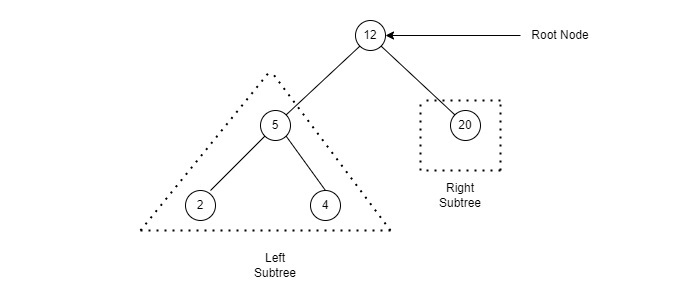 We observe that the root node key (27) has all less-valued keys on
the left sub-tree and the higher valued keys on the right sub-tree.
We observe that the root node key (27) has all less-valued keys on
the left sub-tree and the higher valued keys on the right sub-tree.
- The left sub-tree of a node has a key less than or equal to its parent node's key.
- The right sub-tree of a node has a key greater than to its parent node's key.
left_subtree (keys) ≤ node (key) ≤ right_subtree (keys)
Representation
BST is a collection of nodes arranged in a way where they maintain BST properties. Each node has a key and an associated value. While searching, the desired key is compared to the keys in BST and if found, the associated value is retrieved.Following is a pictorial representation of BST −
We observe that the root node key (27) has all less-valued keys on
the left sub-tree and the higher valued keys on the right sub-tree.Basic Operations
Following are the basic operations of a tree −- Search − Searches an element in a tree.
- Insert − Inserts an element in a tree.
- Pre-order Traversal − Traverses a tree in a pre-order manner.
- In-order Traversal − Traverses a tree in an in-order manner.
- Post-order Traversal − Traverses a tree in a post-order manner.
Node
Define a node having some data, references to its left and right child nodes.struct node { int data; struct node *leftChild; struct node *rightChild; };
Search Operation
Whenever an element is to be searched, start searching from the root node. Then if the data is less than the key value, search for the element in the left subtree. Otherwise, search for the element in the right subtree. Follow the same algorithm for each node.Algorithm
struct node* search(int data){
   struct node *current = root;
   printf("Visiting elements: ");

   while(current->data != data){

      if(current != NULL) {
         printf("%d ",current->data);

         //go to left tree
         if(current->data > data){
            current = current->leftChild;
         }//else go to right tree
         else {
            current = current->rightChild;
         }

         //not found
         if(current == NULL){
            return NULL;
         }
      }
   }
   return current;
}
Insert Operation
Whenever an element is to be inserted, first locate its proper location. Start searching from the root node, then if the data is less than the key value, search for the empty location in the left subtree and insert the data. Otherwise, search for the empty location in the right subtree and insert the data.Algorithm
void insert(int data) {
   struct node *tempNode = (struct node*) malloc(sizeof(struct node));
   struct node *current;
   struct node *parent;

   tempNode->data = data;
   tempNode->leftChild = NULL;
   tempNode->rightChild = NULL;

   //if tree is empty
   if(root == NULL) {
      root = tempNode;
   } else {
      current = root;
      parent = NULL;

      while(1) {
         parent = current;

         //go to left of the tree
         if(data < parent->data) {
            current = current->leftChild;
            //insert to the left

            if(current == NULL) {
               parent->leftChild = tempNode;
               return;
            }
         }//go to right of the tree
         else {
            current = current->rightChild;

            //insert to the right
            if(current == NULL) {
               parent->rightChild = tempNode;
               return;
            }
         }
      }
   }
}


No comments:
Post a Comment