
Rexx (Restructured Extended Executor) is designed to be a
scripting language. Its goal is to make scripting as easy, fast,
reliable, and error-free as possible. Many programming languages are
designed for compatibility with older languages, and are written for
specific audiences or platforms.
Rexx ignores extraneous objectives. It was designed from day one to be powerful, yet easy to use.
Rexx was designed and first implemented, in assembly language, as an 'own-time' project between 20th March 1979 and the middle of 1982 by Mike Cowlishaw of IBM, originally as a scripting programming language to replace the languages EXEC and EXEC 2. It was designed to be a macro or scripting language for any system. As such, Rexx is considered a precursor to Tcl and Python. Rexx was also intended by its creator to be a simplified and easier to learn version of the PL/I programming language.
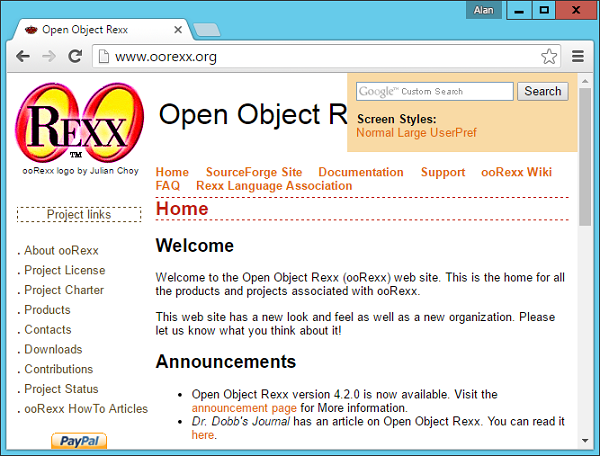
Rexx ignores extraneous objectives. It was designed from day one to be powerful, yet easy to use.
Rexx was designed and first implemented, in assembly language, as an 'own-time' project between 20th March 1979 and the middle of 1982 by Mike Cowlishaw of IBM, originally as a scripting programming language to replace the languages EXEC and EXEC 2. It was designed to be a macro or scripting language for any system. As such, Rexx is considered a precursor to Tcl and Python. Rexx was also intended by its creator to be a simplified and easier to learn version of the PL/I programming language.
Features of Rexx
Rexx as a programming language has the following key features −- Simple syntax
- The ability to route commands to multiple environments
- The ability to support functions, procedures and commands associated with a specific invoking environment.
- A built-in stack, with the ability to interoperate with the host stack if there is one.
- Small instruction set containing just two dozen instructions
- Freeform syntax
- Case-insensitive tokens, including variable names
- Character string basis
- Dynamic data typing, no declarations
- No reserved keywords, except in local context
- No include file facilities
- Arbitrary numerical precision
- Decimal arithmetic, floating-point
- A rich selection of built-in functions, especially string and word processing
- Automatic storage management
- Crash protection
- Content addressable data structures
- Associative arrays
- Straightforward access to system commands and facilities
- Simple error-handling, and built-in tracing and debugger
- Few artificial limitations
- Simplified I/O facilities


No comments:
Post a Comment